
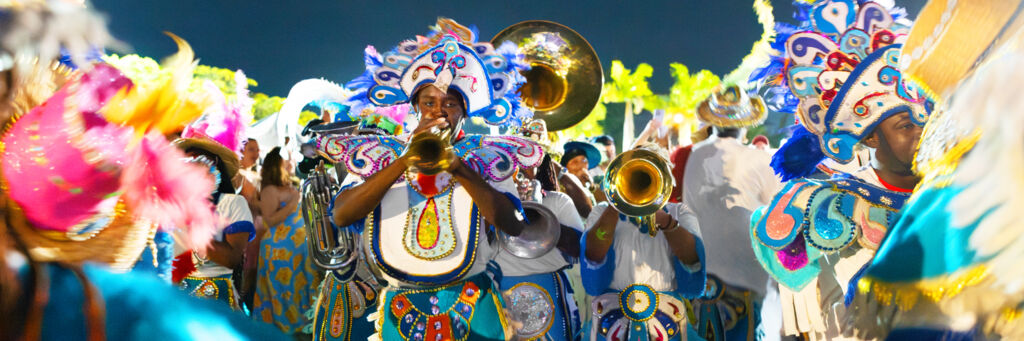
Turks and Caicos Junkanoo
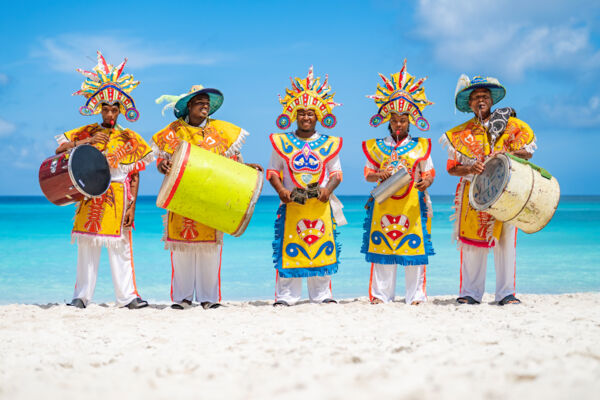
Junkanoo is a type of music and costumed parade practiced in the Turks and Caicos Islands. Today, it primarily takes place on the island of Providenciales. While its exact origins are debated among historians, this type of Caribbean carnival celebration likely originated in The Bahamas between the 18th and 19th centuries among enslaved African people.
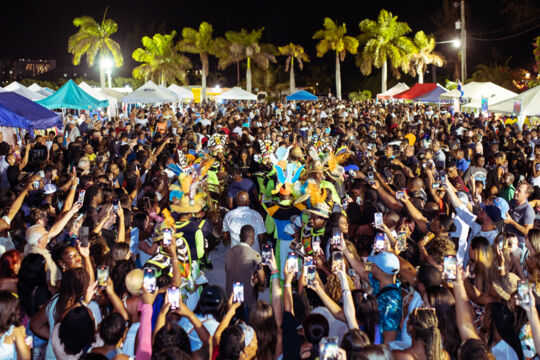
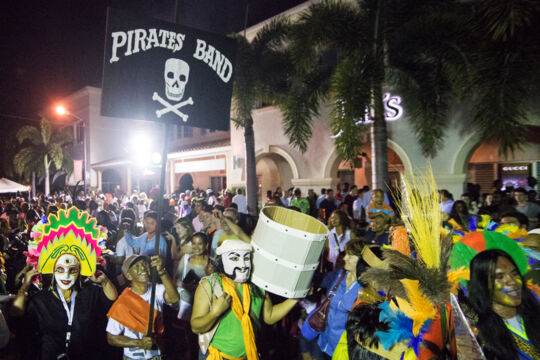
Junkanoo is a much smaller-scale affair here than it is in The Bahamas. The largest performance happens on Boxing Day at the annual Maskanoo parade in Grace Bay.
Providenciales is the only island in the country where visitors can see regular performances (or a rush, as parades are called). Weekly rushes are held at the Fish Fry in The Bight and at Da Conch Shack restaurant in Blue Hills.
It's also common to see performers on Grace Bay Beach on Christmas Day and during New Year's Eve.
Junkanoo's Origins
There are several possible root meanings for the word junkanoo. It may be a anglicization of the French gens inconnus (meaning 'unknown people' and referring to the performers' disguises) or the Scottish junk enoo (which translates to 'junk enough'). It may also be an adaptation of John Canoe, the anglicized name of a tribal chief from modern-day Ghana who fought against Dutch conquest in the early 1700s (and who was seen as a war hero among many enslaved Africans).
Junkanoo shares similarities with other traditional practices that evolved throughout the Caribbean, including rhythmic drumming, dressing up in costume, and the use of traditional characters.
Unlike other carnivals that take place in the days leading up to the Christian holiday of Lent, Junkanoo takes place around Christmas and New Year's Eve. It was historically celebrated in the early hours of Christmas morning, which was one of the few days per year that slaves were granted leave by their masters. In the early 1930s, Junkanoo in The Bahamas was moved to December 26th (Boxing Day) to appease church authorities who considered it pagan and unholy.
Like The Bahamas, Turks and Caicos Junkanoo takes place on Boxing Day.
Instruments and Music
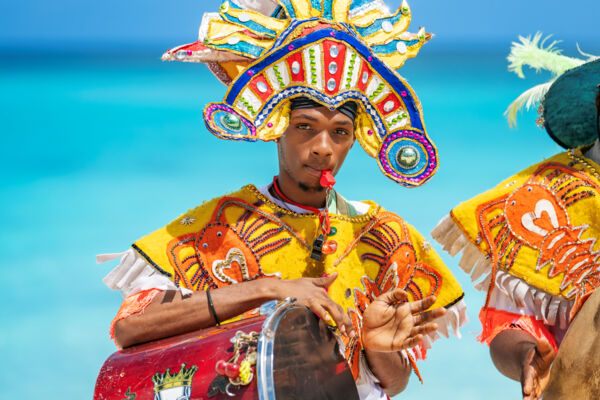
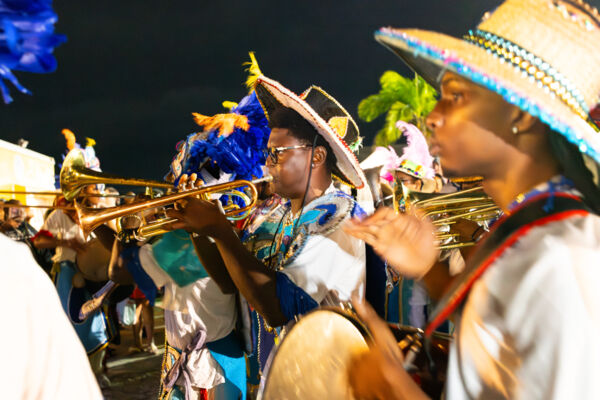
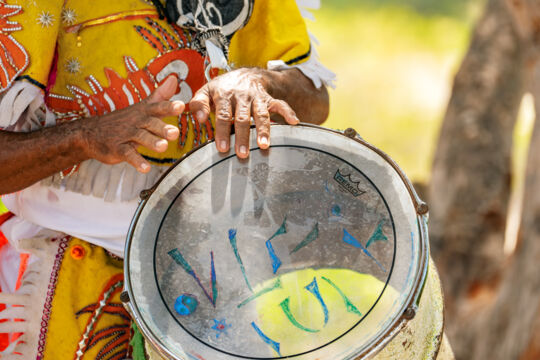
As many as a dozen instruments can make up a junkanoo band. These include percussion instruments like goatskin and synthetic drums, shakers and metal guiros, and cowbells; brass instruments like trumpets, trombones, saxophones, and tubas; and whistles and signal horns.
One of the more unique instruments is what has locally become known as a kalunka (or lunka in The Bahamas)—a suspended metal bar with two cowbells and two jam blocks (the bar is attached to the player with a harness) that the player beats in varying combinations with drumsticks. These instruments are handmade.
There is typically no singing or lyrics to accompany songs. Junkanoo music follows a call-and-response pattern, where one set of instruments performs a series of beats and notes as a call and another set performs a different musical phrase as an answer. This pattern is repeated over and over again, creating a memorable rhythm. Some modern performances also include covers of popular songs (with the melody carried by the brass instruments).
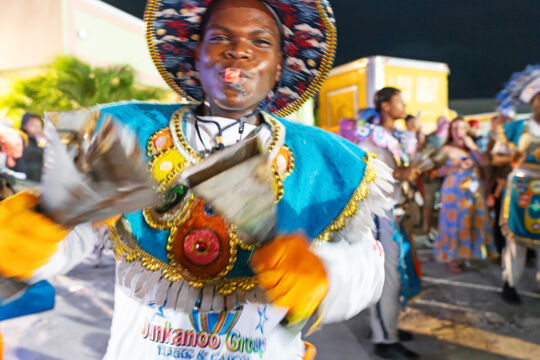
Costumes
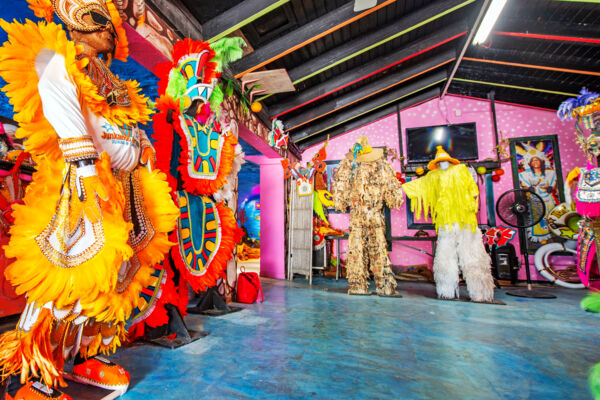
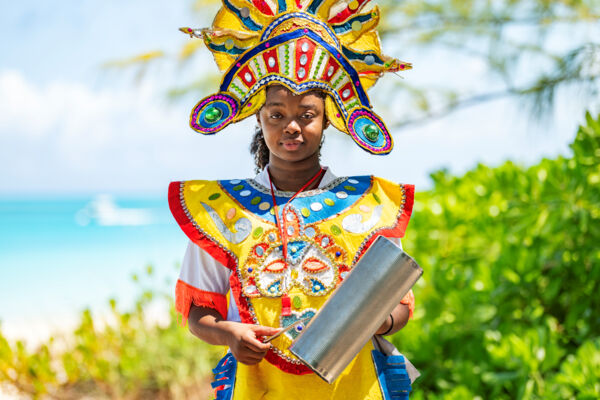
Modern-day costumes are typically constructed from a cardboard base that is shaped with wire and contact cement, then painted or covered with a felt or crepe paper layer. Metallic beads, tinsel, feathers, fabric tassels, and more are added to the surface of the costume in varying patterns. Blue, yellow, pink, orange, red, and lime green are popular colors used in the local costumes.
Turks and Caicos junkanoo costumes tend to have several components, which include an apron or skirt (a belt with decorative panels that hang from the waist to the knees in the front and back), a chest piece and shoulder pieces, and a decorated headpiece or hat with feathers. These costumes can take weeks to produce. In the case of Maskanoo, new costumes are produced every year.
History of Turks and Caicos Junkanoo
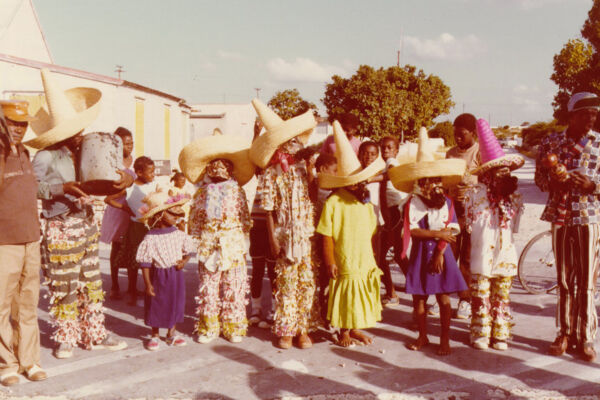
The Turks and Caicos Islands has shared a close history with The Bahamas for many centuries, and at one point was governed by The Bahamas for the better part of a century (emancipating in 1848).
After the collapse of the sea salt trade—which was the backbone of the archipelago’s economy for hundreds of years—during the mid-20th century, many Turks and Caicos Islanders left the islands in search of better opportunities. Some moved to The Bahamas, and returned bringing elements of the culture and vernacular with them. Junkanoo even inspired the name of The Junkanoo Club, a social club on Grand Turk founded in the early 1970s by JAGS McCartney to discuss politics and current affairs.
The first Junkanoo Festival was hosted in the Turks and Caicos Islands in the 1980s when Bahamian-Turks and Caicos Islander Kitchener Penn was contracted by the government to organize the show.
While Junkanoo is a more recent cultural phenomenon here, written records indicate that celebrations with music and dancing did take place on Christmas Day in the archipelago among enslaved people. These were known as the masses, or massin’ (masquerading). Dressing up and hiding one’s identity became an element of this annual event where groups of men would stop at various dwellings throughout the night into the early hours of the morning playing music, dancing, and performing tricks.
Junkanoo Bands
The largest and oldest junkanoo band in the country is We Funk. Originally based on South Caicos, they now perform weekly on Providenciales.
Junkanoo performances at the Fish Fry or Da Conch Shack typically see about 30–50 performers (primarily musicians, but in some cases dancers as well). Maskanoo is the largest rush event of the year, and the performance includes costumed dancers, elaborate parade floats, and baton twirlers.
Booking a junkanoo band as entertainment has become a popular practice for private events and weddings. A few hotels host their own performances for guests around the holidays (like Beaches Turks & Caicos’ Junkanoo Jump Up).
The Junkanoo Museum
This museum on Providenciales is an interesting place to learn about the local history of Junkanoo. The typical tour takes less than an hour and explores the handmade costumes, props, and instruments used by local band We Funk. Visitors can try on costumes and test out some of the instruments on display.