
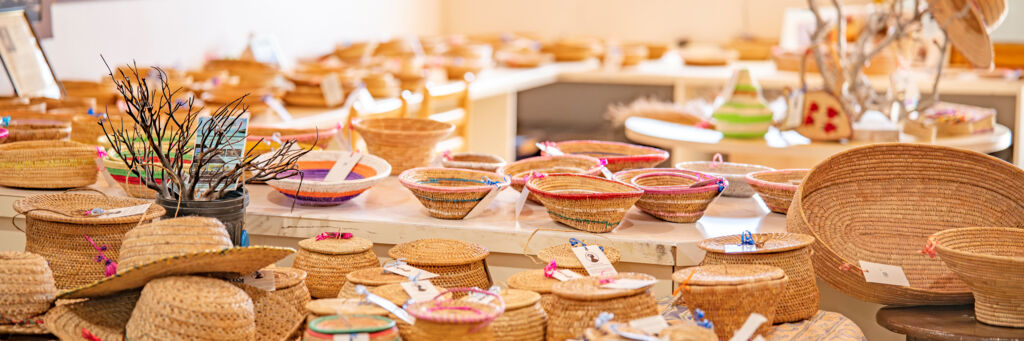
Turks and Caicos Straw Work & Basket Weaving
Straw work is a traditional craft practiced in the Turks and Caicos Islands, and particularly on North Caicos and Middle Caicos. It involves the lengthy and intensive process of cutting, drying, and weaving the leaves of several species of local palm and grass into functional and ornamental crafts like baskets, bowls, purses, place mats, fans, and hats.
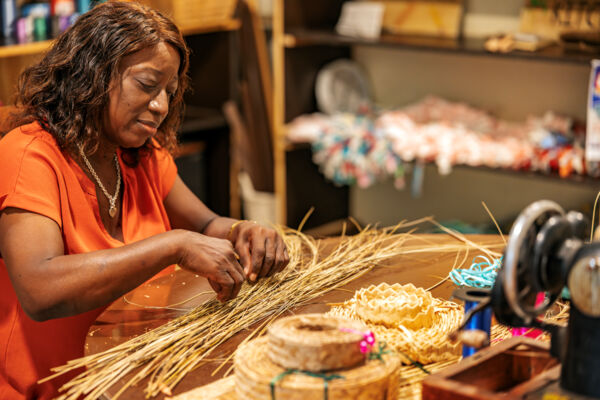
Today, most straw work is produced by women artisans working with the Middle Caicos Co-op.
Straw work crafts are unique souvenirs that are known for their remarkable quality and durability (with proper care, these sturdy baskets can last for decades). They are sold at the co-op store at Major Hill on North Caicos as well as at the museums on Providenciales and Grand Turk.
History
Local straw work and basket making likely began around the 18th century, primarily in the Caicos Islands where several Loyalist cotton plantations were established after the American Revolutionary War.
These plantations were worked by African slaves, and the slaves brought with them various traditions and practices from their ancestors. Straw work was likely one of them—similar handicrafts made from dried grasses (like the bolga baskets of Ghana) are produced in numerous African countries.
After the collapse of the local cotton industry, life on the Caicos Islands became increasingly difficult. Former slaves who remained had to make use of locally available foods and materials to survive.
Using plants found in the islands, they harvested the materials and dried them to produce various functional objects—a simple bound cluster of palm fronds could be used as a whisk broom, or for whipping away pesky mosquitoes.
Tightly woven and coiled fanner baskets—one of the most impressive locally produced crafts—were used to carry water and to winnow (or separate) maize grains from chaff (or husk) to make grits.
The Process
Straw work begins with harvesting the raw materials. All of the grasses and palms used in straw handicrafts, such as fanner grass, silver top palm, and buffalo top palm (which was also used to create the thatch roofs on early island homes), are found locally.
Once materials are harvested, they can take between 2 and 3 weeks to dry. The dried grasses are surprisingly strong and don't tend to break during the weaving process. Sometimes, artisans dampen them with water to make them more flexible.
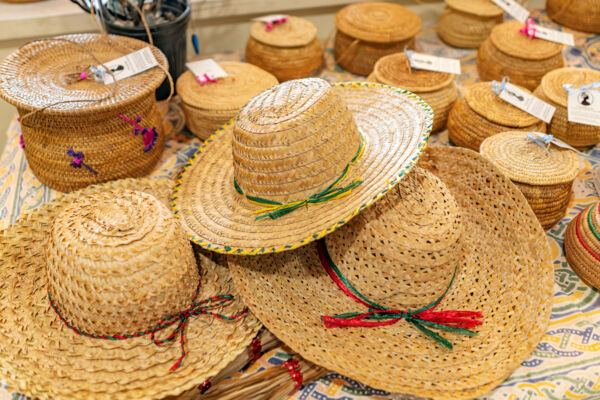
The construction process depends on the craft. Dried silver top palms are typically plaited into narrow strips between 1 and 3 inches wide, then stitched together with a needle and grass to produce wide-brimmed hats or handbags.
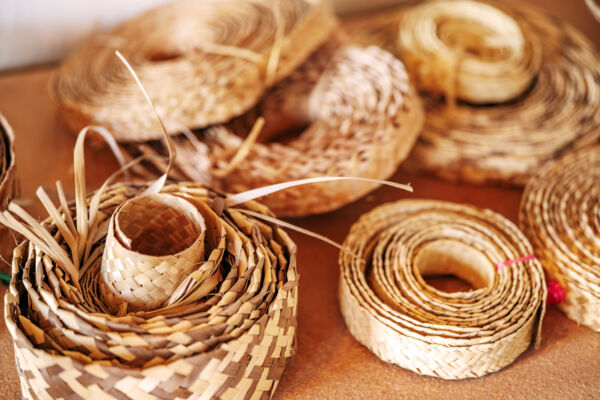
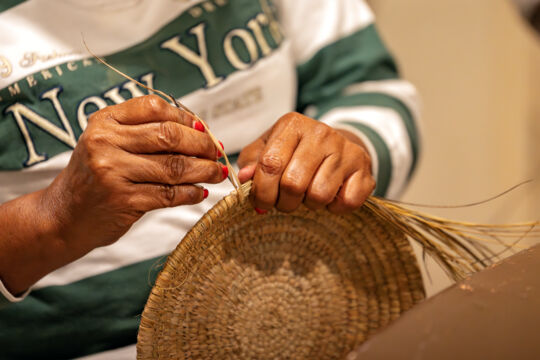
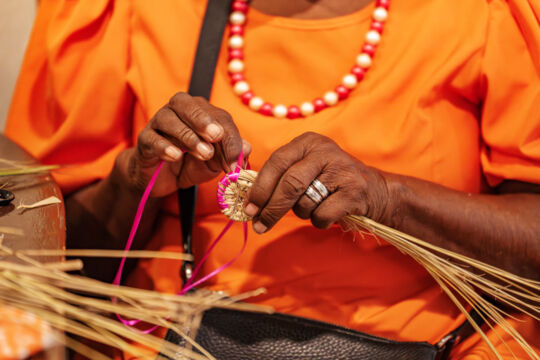
Fanner grass crafts (such as baskets) start with a bundle of fanner grass, around which tight stitches are made using a needle and dried grass in place of thread. Grass is continually added to the bundle as stuffing.
Historically, colorful embellishments would have been made by dyeing the grass with natural pigments. Most modern crafts achieve this effect with plastic ribbon.
The quickest of crafts, such as a drink coaster, can be made in a few hours. More complex crafts like the fanner grass basket—which involves sewing very tight knots around a cluster of fanner grass and progressively bending the basket into a concave shape—can take weeks to make.
Artisans often specialize in a certain type of craft based on personal preference (for example, baskets made from fanner grass or handbags made from silver top palm).
The Middle Caicos Co-op
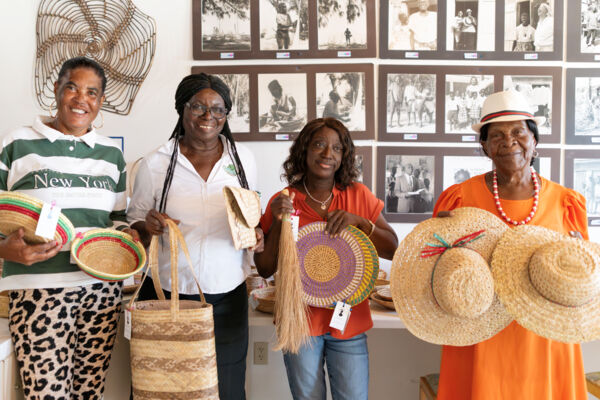
Prior to the founding of the Middle Caicos Co-op in 1998, many women learned how to make baskets and other straw crafts through the Women's Federation, a local community group.
The co-op was established in 1998 as a volunteer project to encourage the continuation of straw work in the islands and to provide artisans fair compensation for their work. As of 2026, there are approximately 18 artisans actively involved in the cooperative.
The workshop was originally based in the settlement of Conch Bar, but has since moved to Major Hill. The co-op has also supported other traditional crafts, such as the carving of model Caicos sloops. These miniature boats are on display at their shop and are raced annually in the Valentine's Day Cup at Bambarra Beach.
Where to Buy Straw Work
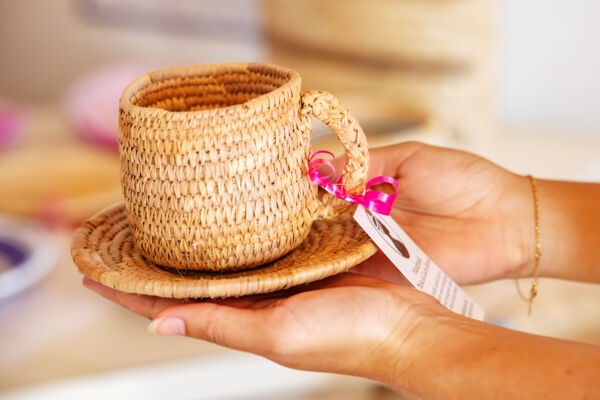
The co-op store at Major Hill is the best place to purchase Turks and Caicos straw work. Not only do they have the largest selection of straw crafts for sale—from hats and hand fans to niche items like hand-woven tea cups and Christmas ornaments—but it also functions as a workspace for artists. Various other local items, including local books, are available for purchase at the shop.
Some co-op crafts are also sold at the shops at Bellefield Landing, where the North Caicos ferry terminal is located.
On Providenciales, baskets and handbags can be purchased at the National Museum & Heritage Site and at Anna's Gallery in the Saltmills Plaza. Likewise, the Turks and Caicos National Museum on Grand Turk sells a small collection of co-op crafts.